
Every sponsor licence holder understands the importance of UKVI compliance. Yet, for many HR teams, the challenge isn’t knowing what needs to be done – it’s keeping track of every deadline, document and reporting responsibility while balancing recruitment, onboarding and day-to-day employee management.
This guide has been created to help sponsor licence holders review their current compliance processes, identify common gaps and understand what it takes to remain audit ready. Whether you’re preparing for a Home Office compliance visit or simply looking to strengthen your day-to-day approach, this practical checklist will help you assess where you stand and where improvements could make a real difference.
Monday Morning. And Compliance Can’t Wait.
Your HR inbox is already overflowing.
A new employee is starting today.
Payroll needs confirmation about a sponsored worker’s visa status.
A department manager asks whether an employee’s Right to Work follow-up has already been completed.
Before you’ve even finished your first coffee, another email arrives.
“Can you confirm we’re fully prepared if the Home Office carries out a compliance visit?”
Suddenly, everything else feels less important.
You open one spreadsheet.
Then another.
Someone tells you the latest employee records are stored on the shared drive.
Another colleague says they updated a different version last week.
Your Outlook calendar contains reminders, but you’re not completely sure they’re all current.
The information exists somewhere.
Finding it quickly is another matter.
If this sounds familiar, you’re not alone.
For many sponsor licence holders across the UK, this isn’t an unusual situation. It’s simply how compliance has evolved over time – through spreadsheets, shared folders, email reminders and manual processes that were never designed to manage growing compliance responsibilities.
The challenge isn’t that HR teams don’t care.
The challenge is that compliance depends on hundreds of small tasks being completed accurately, consistently and on time.
When those tasks are managed across multiple systems, the risk of something being overlooked naturally increases.
Why Staying Compliant Has Become More Challenging
Every HR professional understands the importance of maintaining compliance.
The rules themselves aren’t usually the biggest obstacle.
Most organisations already know they must:
- Maintain accurate employee records.
- Complete and retain Right to Work evidence.
- Monitor visa expiry dates.
- Report relevant changes within required timescales.
- Keep documentation ready for inspection.
- Demonstrate ongoing compliance with sponsor licence duties.
Knowing what needs to be done isn’t the difficult part.
Doing it consistently, every day, across every sponsored worker is where organisations often struggle.
As businesses grow, compliance becomes increasingly complex.
A company with five sponsored workers faces very different challenges from one managing fifty or hundreds of employees across multiple locations.
Each employee represents another set of important dates, documentation requirements, reporting obligations and follow-up actions.
Without clear visibility, even well-managed HR teams can find themselves spending more time searching for information than acting on it.
Compliance Doesn’t Usually Fail Because Someone Didn’t Care
One of the biggest misconceptions about UKVI compliance is that problems only occur when employers ignore their responsibilities.
In reality, that’s rarely the case.
Most compliance issues begin with something much smaller.
A visa renewal date wasn’t updated after new documentation was received.
A follow-up Right to Work check remained on someone’s personal task list instead of being visible to the wider HR team.
An employee changed their address, but the latest records weren’t reflected across every system.
Important documents existed, but locating them during an audit took far longer than expected.
None of these situations happen because HR professionals lack knowledge or commitment.
They happen because manual processes rely heavily on memory, individual ownership and multiple disconnected systems.
As workloads increase, so does the possibility of small administrative gaps becoming larger compliance risks.
The Hidden Cost of Manual Compliance
When people talk about UKVI compliance, conversations often focus on penalties, audits and sponsor licence enforcement.
Those risks are real.
But there is another cost that many organisations experience long before any official inspection takes place.
It’s the hidden cost of managing compliance manually.
Think about how much time HR teams spend:
- Searching for employee documents across multiple folders.
- Checking whether visa expiry dates have already been reviewed.
- Following up with managers for missing information.
- Updating several spreadsheets with the same employee details.
- Preparing evidence whenever compliance information is requested.
- Double-checking calendars to ensure nothing has been overlooked.
Each individual task may only take a few minutes.
Collectively, they consume hours every week.
More importantly, they create uncertainty.
Instead of feeling confident that compliance is under control, HR teams often find themselves asking the same questions repeatedly.
“Did we already complete that check?”
“Has someone updated this record?”
“Which spreadsheet contains the latest information?”
Compliance shouldn’t depend on finding the right spreadsheet or hoping an Outlook reminder hasn’t been dismissed.
It should be built into everyday HR operations.
A Checklist Can Reveal More Than You Think
Before introducing new processes or considering new technology, it’s worth taking an honest look at how your organisation currently manages UKVI compliance.
The purpose of this checklist isn’t to catch organisations out.
It’s to highlight opportunities for improvement.
Some businesses will discover that their existing processes continue to work well.
Others may identify small gaps that become increasingly difficult to manage as their workforce grows.
The important thing is recognising those gaps before they become problems.
Ask yourself the following questions, not just from an HR perspective, but from the viewpoint of someone carrying out a Home Office compliance visit.
The UKVI Compliance Checklist Every Sponsor Licence Holder Should Review
1. Can you see every sponsored worker’s visa expiry date in one place?
If someone asked for a list of all upcoming visa expiry dates today, could you produce it within minutes?
Or would you need to search through multiple spreadsheets, emails or employee files?
Having a central view of visa expiry dates allows HR teams to prioritise upcoming actions before deadlines become urgent.
Having a central view of visa expiry dates allows HR teams to prioritise upcoming actions before deadlines become urgent with the right UKVI Compliance Software
2. Are Right to Work records complete, secure and easy to retrieve?
Completing a Right to Work check is only one part of the process.
The evidence also needs to remain organised, secure and readily available when required.
Ask yourself:
- Can authorised HR staff access documents quickly?
- Are follow-up checks scheduled where required?
- Is documentation stored consistently across every employee?
Effective Right to Work Checks help businesses maintain accurate records and stay compliant.
3. Are employee eVisa records reviewed regularly?
As immigration processes continue to evolve, maintaining visibility over digital immigration status is becoming increasingly important.
Rather than waiting until documentation is needed, organisations should ensure employee records remain current and regularly reviewed.
Rather than waiting until documentation is needed, organisations should ensure employee records remain current and regularly reviewed through effective eVisa Monitoring
4. Do you receive reminders before important compliance deadlines?
A calendar reminder on one person’s computer isn’t always enough.
Effective compliance depends on timely, visible reminders that help HR teams take action before deadlines arrive, not after they’ve passed.
Compliance Radar approach helps organisations stay ahead of key dates.
5. Are Your Employee Records Accurate, Complete and Easy to Access?
Every sponsored worker generates a significant amount of information throughout their employment journey.
From their initial Right to Work evidence and visa documentation to changes in job roles, salaries and contact details, every record contributes to demonstrating compliance.
The question isn’t whether these records exist.
It’s whether they’re organised in a way that allows your HR team to find them quickly.
Imagine receiving notice of a Home Office compliance visit.
Would you feel confident retrieving every required document within minutes?
Or would different team members begin searching through shared drives, email attachments and filing systems to piece everything together?
The more places your information is stored, the more difficult it becomes to prove that your compliance processes are under control.
Centralised employee records don’t simply improve organisation, they give HR teams confidence that the right information is always available when it’s needed.
Explore how People & Operations can help keep your workforce information organised.
6. Can You Demonstrate Ongoing Compliance, Not Just Historical Compliance?
One of the most common misconceptions about sponsor licence compliance is that it’s only about keeping historical records.
In reality, UKVI expects organisations to demonstrate that compliance is an ongoing process.
This means showing that employee information is actively maintained, reviews are carried out when required and changes are managed consistently.
Consider questions such as:
- Are employee contact details reviewed regularly?
- Have salary changes been recorded correctly?
- Are sponsored workers still carrying out the role described in their sponsorship?
- Are reporting responsibilities clearly understood within your HR team?
Compliance isn’t a document you prepare once a year.
It’s a continuous responsibility.
7. Do You Know Who Is Responsible for Each Compliance Task?
As organisations grow, compliance responsibilities often become shared across multiple people.
Recruitment may manage onboarding.
HR may oversee employee records.
Payroll may handle salary updates.
Line managers may monitor attendance and changes within their teams.
When responsibilities become fragmented, it’s surprisingly easy for important tasks to fall between departments.
That’s why clearly assigning ownership matters.
Every compliance activity should have a defined owner, clear deadlines and visibility across the wider HR team.
When everyone assumes someone else has completed a task, nobody can be certain it has actually been done.
8. Could You Confidently Handle a Home Office Compliance Visit Tomorrow?
This is perhaps the most important question of all.
Imagine receiving notification that the Home Office intends to visit your organisation.
Would your first reaction be confidence?
Or concern?
Would your HR team immediately know where every required document is stored?
Could they quickly demonstrate Right to Work evidence, visa expiry monitoring, employee records and reporting history?
Or would several days be spent gathering information from different locations before feeling prepared?
Being audit ready isn’t about expecting an inspection every week.
It’s about having confidence that your compliance processes work every day, not only when someone asks to see them.
When Small Compliance Gaps Become Bigger Problems
Very few organisations experience compliance issues because of one major mistake.
More often, problems develop through a series of small oversights.
A reminder isn’t updated.
A document is stored in the wrong folder.
An employee’s details change but aren’t reflected everywhere.
A follow-up review is delayed because another urgent priority takes precedence.
Individually, these issues seem minor.
Collectively, they create uncertainty.
Over time, uncertainty becomes risk.
That’s why the strongest compliance strategies focus on preventing small issues before they become larger ones.
Why Spreadsheets Eventually Reach Their Limit
Spreadsheets have helped HR teams manage information for years.
They’re familiar, flexible and inexpensive.
For smaller organisations, they may even be sufficient.
The challenge begins when businesses grow.
More employees mean more records.
More sponsored workers mean more visa expiry dates.
More compliance obligations mean more reminders, more documentation and more opportunities for human error.
Spreadsheets weren’t designed to provide real-time visibility across complex compliance activities.
They depend on people remembering to update them.
They rarely notify the right individuals automatically.
Version control becomes increasingly difficult.
And when multiple team members edit the same information, confidence in the accuracy of that information gradually decreases.
Eventually, organisations reach a point where managing compliance becomes more about maintaining spreadsheets than managing people.
That isn’t where HR teams create value.
The Shift Towards Smarter Compliance Management
Across the UK, many organisations are changing the way they manage sponsor licence compliance.
Not because the regulations have suddenly become more demanding.
But because expectations around efficiency, visibility and accountability have changed.
HR professionals today are expected to support recruitment, employee wellbeing, performance management, payroll, workforce planning and compliance, all at the same time.
The more administrative work that can be simplified, the more time HR teams have to focus on strategic priorities.
This is where technology begins to make a genuine difference.
Not by replacing HR expertise.
But by making that expertise easier to apply consistently.
Imagine beginning each day with a clear overview of upcoming compliance actions.
Instead of wondering what might have been missed, you know exactly what requires attention.
Instead of searching for documents, they’re already organised.
Instead of relying on manual reminders, important deadlines are visible before they become urgent.
Compliance stops feeling reactive.
It becomes proactive. And that change transforms the way HR teams work.
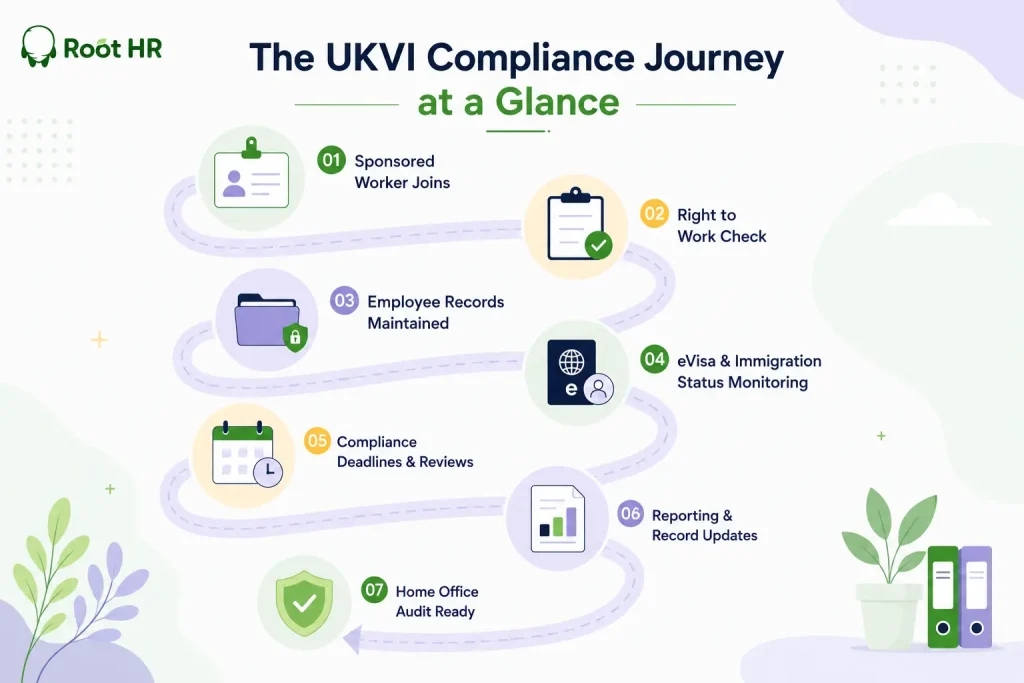
The UKVI Compliance Journey at a Glance
Understanding how compliance activities connect across the employee lifecycle can help organisations identify potential gaps and create more effective compliance processes.
How Modern HR Teams Stay Ahead of UKVI Compliance
Every organisation manages compliance differently. Some rely on spreadsheets, shared folders and calendar reminders, while others use dedicated systems to keep everything organised.
The difference isn’t simply the tools they use, it’s the confidence they have in their processes.
When compliance information is easy to access, deadlines are visible and employee records are kept up to date, HR teams spend less time chasing paperwork and more time supporting their people.
As organisations grow, many find that moving away from manual processes helps reduce administrative pressure while making compliance easier to manage every day.
Why More Employers Are Moving Beyond Manual Compliance
Spreadsheets and manual reminders can work for smaller teams, but they often become difficult to manage as responsibilities increase.
More sponsored workers mean more visa expiry dates, more Right to Work reviews and more documentation to maintain.
Instead of relying on multiple spreadsheets or disconnected systems, many organisations are choosing compliance software that brings everything together in one place. This provides better visibility, reduces manual effort and helps HR teams stay ahead of important compliance activities.
How RootHR Supports Sponsor Licence Holders
RootHR is designed to simplify the day-to-day management of UKVI compliance by bringing together the information HR teams rely on most.
Whether you’re tracking visa expiry dates, managing Right to Work evidence or monitoring upcoming compliance tasks, everything is organised within a single platform to help reduce administrative effort and improve visibility.
Some of the ways RootHR supports sponsor licence holders include:
- Compliance Radar : Monitor upcoming compliance actions, deadlines and potential risks from one dashboard.
- Right to Work Checks : Organise employee evidence, monitor review dates and maintain compliant records.
- eVisa Monitoring : Keep track of digital immigration status and stay informed about important updates.
- People & Operations : Centralise employee records, making information easier to access and manage.
- Workforce Management : Maintain accurate workforce information while supporting day-to-day HR operations.
Compliance Is Easier When Everything Works Together
UKVI compliance isn’t made up of individual tasks, it relies on accurate records, timely reminders and clear visibility across your workforce.
When these processes work together, HR teams can spend less time searching for information and more time focusing on their people.
Rather than reacting to compliance deadlines, organisations can take a proactive approach that supports both operational efficiency and long-term compliance.
Final Thoughts
UKVI compliance isn’t something to think about only when an audit is approaching. It’s an ongoing responsibility that requires consistent processes, accurate records and regular monitoring.
Taking time to review your compliance approach today can help reduce future risks, improve efficiency and give your HR team greater confidence in their day-to-day responsibilities.
If you’re looking for a simpler way to manage sponsor licence compliance, Right to Work checks and employee records, RootHR’s UKVI Compliance Software provides the tools to help your organisation stay organised, stay compliant and stay audit ready.