For UK employers holding a sponsor licence, a UKVI compliance audit can feel stressful. The thought of an unexpected compliance visit, requests for employee records, or questions about sponsored workers can leave HR teams wondering whether everything is in order.
But a UKVI compliance audit doesn’t have to be something you prepare for at the last minute.
The best approach is to make compliance part of your everyday HR processes rather than treating it as a one-time exercise.
UK Visas and Immigration (UKVI) can conduct compliance checks at different stages of a sponsor’s licence and may carry out announced or unannounced visits. During these checks, sponsors may need to demonstrate that they are meeting their sponsorship duties and maintaining appropriate records.
So, how can your business stay prepared?
Let’s look at the practical steps.
What Is a UKVI Compliance Audit?
A UKVI compliance audit, often referred to as a compliance check or compliance visit, is an assessment carried out by UKVI to determine whether a sponsor is meeting its responsibilities.
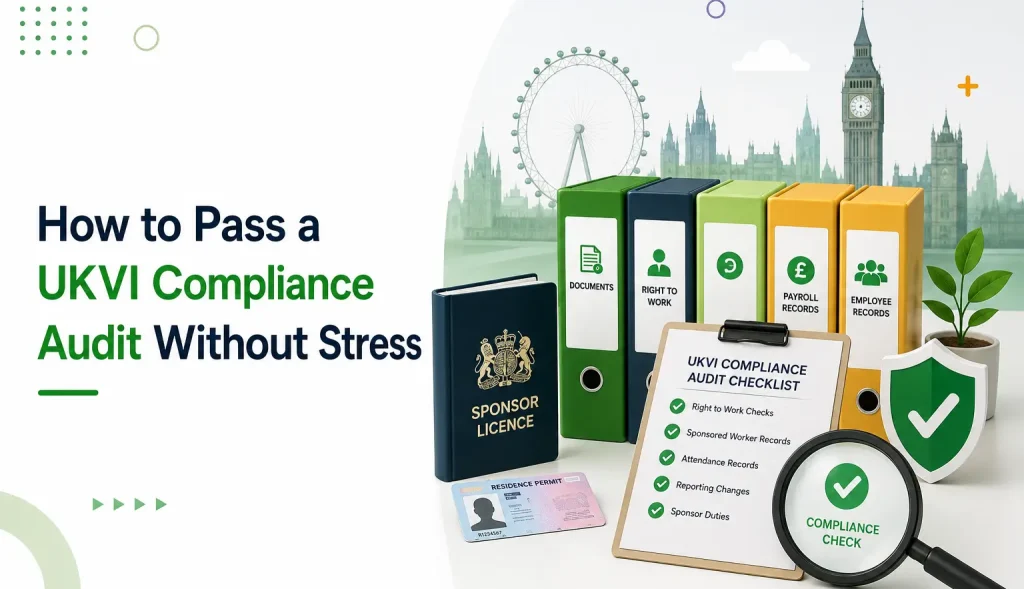
UKVI may check areas such as:
- Whether sponsored workers are genuinely employed in the roles for which they were sponsored
- Right to work documentation
- Employee and sponsored-worker records
- Salary and employment information
- Attendance and absence records
- Recruitment documentation
- Changes relating to sponsored workers
- Whether the organisation is reporting relevant changes to UKVI
- Whether the business is complying with its sponsor duties
UKVI compliance checks can take place before or after a sponsor licence has been granted, and visits may be announced or unannounced.
This means that being “ready for an audit” should not mean preparing documents only when you receive an audit notification.
Your business should ideally be audit-ready every day.
Why Do UKVI Compliance Audits Feel Stressful?
For many businesses, the biggest challenge isn’t necessarily the audit itself.
It’s finding information quickly.
HR teams may have employee information spread across:
- HR software
- Email inboxes
- Shared drives
- Spreadsheets
- Payroll systems
- Paper files
- Recruitment systems
When information is stored in multiple places, it becomes difficult to know whether records are complete and up to date.
For example, an employee’s right to work information may be stored in one system while their absence records are held somewhere else.
If an HR manager needs to produce information quickly, this can create unnecessary pressure.
The solution is not simply to keep more paperwork.
The solution is to create a consistent and organised compliance process.
1. Keep Right to Work Records Up to Date
Right to work checks are one of the fundamental responsibilities employers need to manage.
For sponsored workers and other relevant employees, employers need to maintain appropriate evidence in line with current requirements.
UKVI’s current record-keeping guidance specifically covers evidence relating to right to work, recruitment, salary, skill level and other information for sponsored workers.
Your HR team should therefore have a clear process for:
- Completing right to work checks
- Recording the date of the check
- Keeping the required evidence
- Monitoring relevant expiry dates
- Following up when further checks are required
Don’t wait until an audit to discover that an employee’s documentation is missing.
2. Keep Sponsored Worker Records Organised
Sponsored worker records should be easy to locate and consistently maintained.
Depending on the circumstances, records may include information relating to:
- Right to work
- Recruitment
- Employment
- Salary
- Job role
- Qualifications or skills
- Absence
- Working arrangements
- Relevant communications and reporting
UKVI’s Appendix D sets out the record-keeping duties for Worker and Temporary Worker sponsors.
A useful internal question for HR teams is:
“If UKVI asked for this employee’s records today, could we produce them quickly?”
If the answer is no, there is an opportunity to improve your process.
3. Monitor Changes Instead of Reacting to Them
One of the biggest compliance challenges for growing businesses is keeping track of changes.
Employees change roles.
Salaries change.
Working arrangements change.
Employees take extended periods of absence.
Sponsored workers may leave the business.
Business structures can also change.
These changes can create additional responsibilities for sponsors.
Instead of relying entirely on HR teams to remember every change manually, businesses should establish a system that helps identify important events and prompts the responsible person to take action.
This turns compliance from a reactive process into a proactive one.
4. Make Employee Information Easy to Find
During a compliance check, speed and organisation matter.
If HR teams have to search through several spreadsheets and folders to find basic employee information, the process becomes unnecessarily stressful.
A centralised HR system can help bring important employee information together.
Ideally, your HR team should be able to quickly view information such as:
Employee → Job role → Right to work → Documents → Attendance → Leave → Key dates
Having information organised in one place makes it easier to identify missing records and potential compliance issues before they become bigger problems.
5. Don’t Forget Attendance and Absence Records
Attendance and absence management can also be important when managing sponsored workers.
HR teams should have clear records of:
- Working patterns
- Attendance
- Leave
- Absences
- Extended periods of absence
- Relevant changes to employment
The objective isn’t simply to collect data.
It is to make sure that your records accurately reflect what is happening in your organisation.
6. Review Your Records Regularly
One of the easiest ways to reduce audit stress is to perform your own internal compliance reviews.
Don’t wait for UKVI to identify a problem.
Instead, schedule regular checks.
For example, your HR team could review:
Monthly
- Upcoming right to work dates
- Sponsored worker changes
- Absence records
- Missing employee documents
Quarterly
- Sponsored worker records
- Job and salary information
- Recruitment documentation
- Compliance-related processes
Annually
- Overall sponsor compliance processes
- HR documentation
- Internal responsibilities
- Record-keeping procedures
- Staff training
Regular reviews make it much easier to identify problems while they are still manageable.
7. Make Someone Responsible for Compliance
Compliance becomes difficult when everyone assumes someone else is responsible.
Your organisation should clearly identify who is responsible for managing sponsor compliance.
This may involve your:
- HR manager
- Authorising officer
- Key personnel
- Recruitment team
- Payroll team
- Line managers
Everyone involved should understand their responsibilities and know where the relevant information is stored.
Clear ownership can prevent important tasks from falling through the cracks.
8. Prepare Your Team for an Unexpected Visit
UKVI compliance visits may be announced or unannounced.
That means your business should have a process for responding if a compliance officer arrives unexpectedly.
Your team should know:
- Who should handle the visit
- Who the relevant key personnel are
- Where records are stored
- How employee information can be accessed
- Who should be contacted internally
- How managers should respond to questions
The goal isn’t to create panic.
It is to make sure your organisation can respond calmly and professionally.
9. Don’t Rely Entirely on Spreadsheets
Spreadsheets can be useful for simple tracking.
But as the number of employees and sponsored workers grows, manually monitoring everything becomes increasingly difficult.
A spreadsheet might tell you that an employee’s document expires in three months.
But who is responsible for checking it?
Will someone remember to follow up?
What happens if the employee’s role changes?
What if the spreadsheet isn’t updated?
This is where automation can make a significant difference.
10. Use Technology to Stay Audit-Ready
Modern HR software can help organisations move from manual compliance tracking to a more proactive approach.
Instead of simply storing employee information, a compliance-focused HR platform can help HR teams monitor important events and identify potential issues.
For example, a system can help bring together:
- Right to work information
- Employee records
- Documents
- Absence data
- Attendance
- Sponsored worker information
- Important dates
- Compliance tasks
This gives HR teams better visibility over their workforce.
How Root HR Can Help You Stay Audit-Ready
Preparing for a UKVI compliance audit shouldn’t require a last-minute scramble through spreadsheets, emails and folders.
Root HR helps UK employers bring HR and UKVI compliance processes together in one platform.
With features designed around workforce management and sponsor compliance, Root HR can help businesses improve visibility across areas such as:
Compliance Monitoring
Monitor important compliance information and identify areas that require attention before they become urgent problems.
Right to Work Checks
Keep relevant right to work information organised and make it easier for HR teams to monitor important dates.
eVisa Monitoring
As the UK continues its transition towards digital immigration status, having a structured way to manage relevant employee information can help HR teams stay organised.
Employee & Document Management
Keep important employee information and documents organised instead of relying on disconnected systems.
Workforce Management
Manage attendance, leave and other workforce information alongside your wider HR processes.
The result is a more connected approach to HR and compliance.
A Simple Way to Think About UKVI Compliance
Instead of asking:
“What should we do if UKVI audits us?”
Ask:
“If UKVI audited us tomorrow, would we already be ready?”
That small change in mindset can make a significant difference.
The most effective compliance strategy is not a huge preparation exercise immediately before an audit.
It is a continuous process of:
Monitor → Review → Identify → Act → Record
When these processes become part of everyday HR operations, compliance becomes much less stressful.
UKVI Compliance Audit: Quick Self-Check
Ask your HR team these questions:
- Can we quickly access right to work records?
- Are sponsored worker records complete?
- Are important expiry dates being monitored?
- Do we have a process for tracking changes?
- Are salary and job information kept up to date?
- Are attendance and absence records accurate?
- Does someone clearly own sponsor compliance?
- Could we respond to an unannounced compliance visit?
- Can we quickly identify missing documents?
- Are we relying too heavily on spreadsheets and manual reminders?
If several answers are “no”, it may be time to strengthen your compliance process.
Final Thoughts
A UKVI compliance audit doesn’t need to be a source of panic.
The key is preparation — but preparation should happen before an audit, not because of one.
By keeping accurate records, monitoring changes, reviewing compliance regularly and giving your HR team the right tools, your organisation can become more confident and better prepared.
UKVI guidance makes clear that sponsors have ongoing duties and that compliance checks can happen at different stages of the sponsorship lifecycle.
The goal shouldn’t simply be to “pass an audit.”
It should be to build an HR process where your business is audit-ready every day.
Want to make UKVI compliance easier to manage?
Discover how RootHR combines UKVI compliance, HR management and workforce management in one platform.
Book a demo with RootHR today and see how you can move from manual compliance tracking to a more proactive approach.
Frequently Asked Questions
How often does UKVI conduct compliance audits?
There isn’t a fixed schedule that applies to every sponsor. UKVI may conduct compliance checks at different stages, including after a sponsor licence has been granted. Checks may also be announced or unannounced.
What documents should employers keep for sponsored workers?
The exact records required depend on the sponsor’s circumstances and immigration route. Current UKVI guidance includes records relating to right to work, recruitment, salary, skill level and other evidence.
Can UKVI conduct an unannounced compliance visit?
Yes. Current sponsor guidance states that compliance checks involving visits or interviews can take place on an announced or unannounced basis.
How can HR teams reduce UKVI compliance risk?
HR teams can reduce risk by maintaining accurate records, monitoring sponsored workers, tracking relevant changes, regularly reviewing documentation and clearly assigning responsibility for sponsor compliance.
Can HR software help with UKVI compliance?
HR software can help centralise employee information, documents, important dates and workforce data. A dedicated compliance-focused system can also help HR teams monitor potential issues and stay organised.
Is UKVI compliance a one-time task?
No. Sponsor compliance is an ongoing responsibility. Businesses should treat compliance as part of their regular HR processes rather than something they prepare for only when an audit is expected.