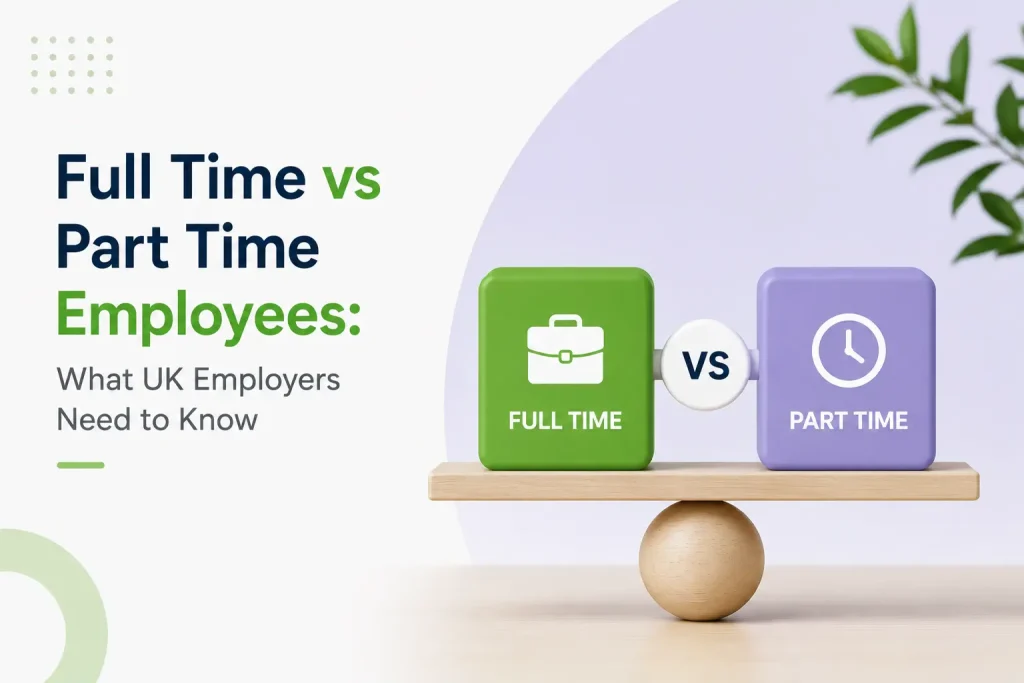
For many UK employers, deciding whether a role should be filled by a full time vs part time employees, or a combination of both is Important because hiring the right employees is one of the biggest decisions a growing business makes.
While both types of employees can contribute valuable skills and support business growth, there are important differences around working hours, contracts, holiday entitlement, pay, and employee management.
For small and medium-sized businesses, understanding these differences helps create fair working arrangements, stay compliant, and manage teams more effectively.
What Is a Full Time Employee?
A full-time employee is someone who works the standard number of hours expected for their role.
In the UK, there is no single legal definition of a full-time employee. However, full-time work commonly means around 35 to 40 hours per week, depending on the employer and industry.
A full-time employee usually has:
- A permanent or fixed-term employment contract
- A regular working schedule
- Full responsibilities for their role
- Access to workplace benefits (depending on company policy)
- The same employment rights as other employees
Full-time roles are common for positions where businesses need consistent availability and ongoing involvement.
What Is a Part Time Employee?
A part-time employee works fewer hours than a comparable full-time employee.
Part-time workers may work:
- Fewer days per week
- Shorter daily shifts
- Flexible schedules
- Specific agreed hours
For example, a part-time employee might work three days per week or only certain shifts.
Part-time employees still have important employment rights and should receive fair treatment compared with full-time employees.
Full Time vs Part Time Employees: Main Differences
| Area | Full-Time Employee | Part-Time Employee |
|---|---|---|
| Working hours | Usually 35–40 hours per week | Fewer hours than full-time |
| Schedule | Often fixed weekly hours | May have flexible or reduced hours |
| Contract | Full-time employment contract | Part-time employment contract |
| Pay | Based on agreed full-time hours | Usually based on hours worked |
| Benefits | May receive company benefits | Often receives benefits on a pro-rata basis |
| Availability | More consistent availability | Reduced availability |
Do Part Time Employees Have the Same Rights as Full Time Employees?
Yes. Part-time employees have many of the same employment rights as full-time employees.
UK employers must not treat part-time workers less favourably simply because they work fewer hours.
Part-time employees are generally entitled to:
- Minimum wage protection
- Paid holiday entitlement
- Rest breaks
- Protection from discrimination
- Workplace rights under employment law
Some benefits may be calculated proportionally based on working hours.
Holiday Entitlement for Full Time vs Part Time Employees
Both full-time and part-time employees are entitled to paid holiday.
The UK statutory minimum is usually:
5.6 weeks of paid holiday per year
For full-time employees, this is commonly:
- 28 days per year for someone working a five-day week
Part-time employees receive the same entitlement calculated proportionally.
Example:
An employee working three days per week would typically receive:
3 days × 5.6 weeks = 16.8 days holiday
Managing holiday accurately becomes harder as teams grow, especially when employees have different schedules.
Full Time vs Part Time Employees: Which Is Better for Employers?
There is no single best option. The right choice depends on the business and the role.
Full time employees may be better when:
- The role requires daily involvement
- Consistent availability is important
- The business needs long-term ownership
- Teams need regular collaboration
Part time employees may be better when:
- Flexibility is needed
- Workload changes throughout the week
- Businesses want to control staffing costs
- Roles only require limited hours
Many successful SMEs use a mix of both.
Managing Full Time vs Part Time Employees
As businesses grow, managing different employee schedules can become complicated.
Employers may need to track:
- Working hours
- Shift patterns
- Holiday requests
- Absences
- Contracts
- Employee documents
- Performance reviews
Without proper systems, HR administration can become time-consuming and increases the risk of mistakes.
An HR system helps businesses keep employee information organised and makes managing different working arrangements easier.
How HR Software Helps Manage Different Employee Types
HR software allows businesses to manage full-time and part-time employees from one place.
With the right HR system, employers can:
- Store employee records securely
- Manage contracts and documents
- Track holidays and absences
- Organise rotas and shifts
- Support performance reviews
- Improve HR compliance
This gives managers more visibility and reduces manual administration.
Final Thoughts
Whether you choose full time vs part time employees depends on your business needs, workload, and goals.
Both types of employees play an important role in modern workplaces. The key is ensuring working arrangements are clear, fair, and properly managed.
For growing UK businesses, having the right HR processes and systems makes managing different employee types much simpler.